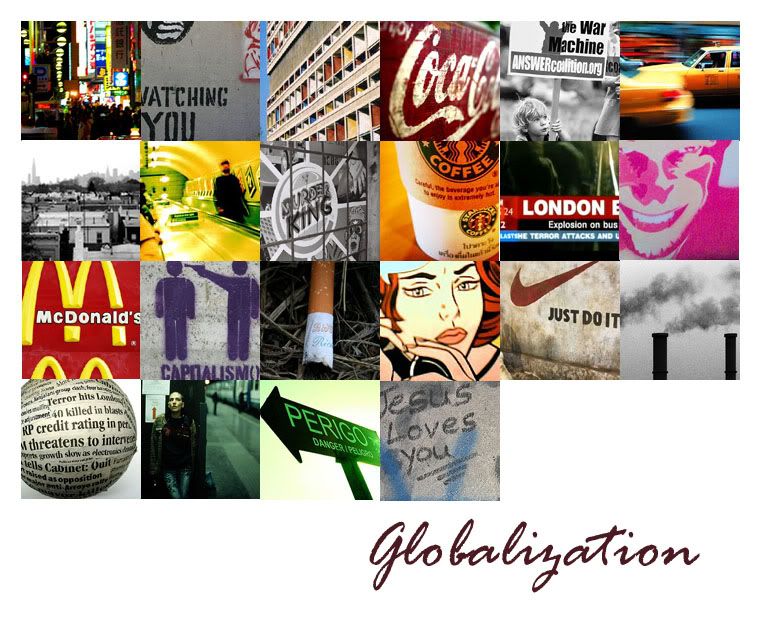

Imagine if globalization did not exist. Would we all then be healthy and happy citizens?
Perhaps one of the first and most characterized examples of the interconnection of Globalization and Health would be the Black Death of mid-14th Century in
It is most commonly believed that the bubonic plague was originally endemic in populations of infected ground rodents in central Asia, as it was a known cause of death among migrant and established populations in that region. However, it is not entirely clear where the fourteenth-century pandemic started. The most popular theory places the first cases in the steppes of central Asia, though some speculate that it originated around northern
Whichever the case, it is evident that the disease, carried by fleas on rodents, was allowed to spread across the globe by trading ships, which stopped at different ports in different regions, allowing the dissemination of the disease. There was no way to put a stop to such – to contain the plague would mean that countries would have to ‘isolate’ themselves, a tactic which would certainly cause them to incur severe losses. Many economies survive on trade and industry. It was simply impossible for trade to halt in any region, therefore the disease continued to spread and spread.
The Black Death even hundreds of years ago resembles what we are facing now. The world is just too interconnected. Just like the spread of bubonic plague cannot be contained to any country, the spread of our modern day SARS, Bird Flu, HIV etc., cannot be contained as well. Globalisation resulted in the breakdown of borders and barriers, and thus the spread of illness comes along with it. As globalisation has allowed us to travel abroad easily, it has allowed us to carried germs and our diseases to other countries around the world, and thus spread it to people even across the globe. After all, being connected to each other, the amount of suffering as depicted in the painting would probably be widespread.
But as I like to argue that Globalisation has fuelled the spread of diseases, I would once more point out that only Globalisation can save us now. With globalisation, the spread of ideas is made faster, and therefore discoveries and scientific inventions made in one country would be available to all. And this means cures. The world would work hand in hand to combat the epidemic. Any epidemic.
In conclusion, I guess we have to accept that Globalisation is here to stay. Perhaps, and imagining is all that we can do, had there been no globalisation, sickness and diseases would have spared some of our countries and its people. But since there is Globalisation, what’s left to do is simply just working together to combat the ills of Globalisation. A double-edged sword many would have imagined and a double-edged sword it would remain.
If globalisation did not exist, we probably would have then allowed disease to wipe us out individually anyway.
the writer plays the role of the environmental and heath expert
[painting from http://www.uwmc.uwc.edu/csepa/mhall/IGS/Plagues/PIA/plagues_in_art.htm , others from Wikipedia ]
-Teresa
| Permalink | Trackbacks |
0 comment (s)
|
0 comment (s)


