
"What are our standards of beauty?" Holstein asked. "We begin
to believe that we need to look like the models in a magazine," she said.
Photographs trigger global aspects of beauty, by Esmeralda Tovar for chicagoflame.com
“Hollywood is a place where
they'll pay you a thousand dollars for a kiss
and fifty cents for your soul.”
Marilyn Monroe
Marilyn Monroe to me was beautiful. For all her voluptuousness, overt-femininity, pouty-lipped poses, and her flirtatious persona, she was, beneath the cake of foundation and lip gloss, distinctly human, much more than the blonde bombshell the media often protrays her to be, and 40 years after the death of this female so iconic of the 1950s, even the 20th century, there are people who agree. Back in a poll conducted in 2003 she beat out Breakfast At Tiffany's star Audrey Hepburn and another favourite Grace Kelly to be named the Most Beautiful Actress. She is the quintessential Hollywood sweetheart; arguably representing the Western ideal of beauty, at least at that point of time.
The beauty of redefinition
There are in fact many who look in that direction for definitions of beauty. American and European film and fashion industries have seen immense growth most spectacularly after the second World War, and with advances in technology the media has propelled their local scenes onto the global stage for all to admire and perhaps to criticise. This cross-fertilization of cultures flourishes hand in hand with globalization, and the two are so intertwined that it has become impossible to tell, even with the benefit of hindsight, which led to the other.
This increased exposure to different (and mostly Western) standards of beauty have led to, as some lament with regret, a swift change in what the younger, more savvy generations deem attractive and desirable in terms of beauty. A more gracious term would be a fusion of tastes, but for cynics many classical Asian standards of beauty have been swept aside with the onslaught of Western notions of what is beautiful. From India to China to Korea and Japan, the trend is particularly pronounced. The distinctly classic melon-seed-shaped face, elongated eyes, petite noses and small pouty lips which the Westerners love to label 'oriental' is being lost on the generation of the 21st century. This side of the world craves the sharp, angular features and lean figures of the West, while they remain infatuated with the exotic features of Asians. In fact, the most beautiful and unique of faces are often thought to be a marriage of the two, a fusion of both the 'hard' and 'soft' features of the East and the West. Mixed heritages intrigue and excite. The result is an ambiguous amalgamation; the new global beauty.
Perhaps the perfect example of the new global face of
beauty is Saira Mohan, a model who’s scored gigs with Chanel, Calvin Klein and
Victoria’s Secret. She owes her sharp features to her father’s north Indian
Punjab ancestry, but her round eyes and light complexion come from her mother’s
French-Irish-Canadian side. Mohan is just Asian enough to suit Western
sensibilities, while still retaining some ambiguity. “She’s one of those
beautiful women who can easily be Italian, British or Spanish,” says fashion
photographer Atul Kasekbar. “And she can very well be an Indian in a sari.” Or
as Mohan told an Indian newspaper recently: “I capitalize on all the angles. I
am what I am, and if they want to pay me for being Punjabi, great. If they want
to pay me for looking Spanish or Italian, wonderful.” Says Calvin Cheng, Asia
head of Elite Model Management Group: “There is an increased awareness of all
things oriental in the West. And with [the rise] of China, I think this trend is
set to continue.”
The Global Makeover By Fred Guterl and Michael Hastings for MSNBC
Newsweek
The supposedly fortunate ones are a genetic product, its encoded for in their genes; the rest of us have to rely on artifical means, and it sounds every bit as unsettling as Barbie is plastic perfection.
The current trend, say Guterl and Hastings, is in many ways an extension of the longstanding influence of Western images in movies and television, accelerated in recent years by the addition of satellite television and the Internet. But the proliferation of cosmetic surgery has given this trend a new twist. Techniques and technologies of plastic surgery are more widely available than ever before. As prices keep coming down, more and more women—and men—are electing to go under the knife in pursuit of an emerging global standard of beauty.
Indeed, the prevalent trend today is surgery. Plastic surgeons are especially busy in China and South Korea, where cosmetic operations performed go up to millions combined. Nose jobs, brest implants, Botox injections, and liposuction techniques have become more readily available and accessible than ever before. Demands fuel this trend, and technology sustains it. From gawky braces to nondescript bottles of peroxide to sophisticated coloured contact lenses, there are more ways to attempt to emulate the global standard available to us than we notice.
The Beauty of Tradition
African Ndebele women consider long necks beautiful, for every year that a young woman is attractive, she is given a gold ring that is welded onto her neck. Most of us will only speak of it as a myth; something we shall never personally see or experience. That to us is mystical, unfathomable. But to them, untouched by media and modernity, it is sacred and beautiful.
Black teeth are considered beautiful in Kalinga province, Vietnam, where tooth-staining is a traditional ritual.
The practice of the tubug reaches its peak during the sunga (rite of incorporation), a dance ceremony that serves as a venue for boys and girls to select their mates. They dress up to be attractive by wearing their besti (clothing), kiring (beads) and baraker (scarf), and making sure that they have shiny, black teeth. This, for them, is nalawad (beautiful). "The tattoo, the black teeth, plus the adornments, they all complement their indigenous concept of beauty," said Salvador.
The vanishing beauty of black teeth, by Niña Marie SB. Mendizabal
(Take a look.)
Indian beauties in the past are very much different from what we perceive them to be today, the most prominent of them being Aishwarya Rai, or the many Indian top ten finalists in the annual Miss Universe pagent, which often comes under fire for apparently promoting superficial notions of beauty.
When the ancient Indian poet Kalidasa wrote his epic tale of
love between Lord Shiva and his consort, Parvati, his vision of female beauty
had little to do with the half-starved waifs of Western catwalks or the
lean-muscled athletes of cereal boxes. To Kalidasa, Parvati was a soft,
voluptuous temptress. In the centuries since, ampleness has remained a great
female virtue in India. This classical image of beauty is inscribed on temple
walls and depicted in sculpture, paintings and literature, including the famous
treatise on esthetics, the Kama Sutra. The ideal Indian beauty, says Alka Pande,
author of “Indian Erotica,” has always been “heavy breasted, with a languorous
gait, large child-bearing hips, full—in every sense of the term—luscious lips.”
The number of slimming centres and diet pills available are horrific indications of the reversing trend of today. Never mind that the spokespersons on billboards were never fat, so to say Never mind, also, that the grand proclaimations of success stories are dubious. Statistics, even photographs, can be faked. Just like silicon breasts. Anything an inch too wide or a pound too heavy is unacceptable. Waif is the new proportion. Twiggy is the new Rubenesque. (If you don't know what I'm talking about, good for you. The truth is scary.)
All it took was one woman--one Miss World, to be precise--for young Nigerians to get hooked on the new concept of slim. Agbani Darego, winner of the less-well-known counterpart to the Universe pagent in 2001, the first African winner in 51 years, was skinny. Her win was inspirational; it represented acceptance of this new beauty ideal by the world. While Nigerians of the older generations do not find her particularly beautiful, for the younger generation, she is an idol.This is not foreign to a culture where eating disorders are a problem amongst the younger generation, but to Nigera, this is a quantum leap from tradition to modernity.
To anyone who has traveled across the continent,
especially in West and Central Africa, the cultural shift is striking. In the
United States slimness may be an ideal, but many ethnic groups in this region
hold festivals celebrating big women. In Niger many women take livestock feed or
vitamins to bulk up.Among the Calabari people in southeastern Nigeria, fat has
traditionally held a cherished place. Before their weddings, brides are sent to
fattening farms, where their caretakers feed them huge amounts of food and
massage them into rounder shapes. After weeks inside the fattening farms, the
big brides are finally let out and paraded in the village
square.
Globalization of Beauty Makes Slimness Trendy, by Norimitsu Onishi for The NY Times
All kinds of beautiful
L’Oreal, the industry leader in cosmetics, now operates 12
research centers around the globe to understand how the company can fine-tune
its products to the unique needs of different cultures. In September, L’Oreal
opened up the Institute for Ethnic Hair and Skin Research in Chicago, devoted to
African-American beauty, and the company has also done similar work in China.
“We’re fighting against an ideal beauty,” says research spokeswoman Patricia
Pineau. Some experts say that greater travel and cultural exchange among Asian
countries is creating more of a Pan-Asian standard of beauty than a Western
one.


Dove has also launched the Campaign for Real Beauty, in support of beauty in all shapes, sizes, colours and ages. In a series of six advertisments of the campaign presents us questions challenging a stereotype about age, hair colour, skin tone, size or body shape. The Dove Self-Esteem Fund has been set up to make donations to groups working to improve women's self-esteem. Dove are currently working with the Eating Disorders Association to educate and inspire young women to feel more beautiful more of the time, through an initiative in schools.
These are encouraging signs amidst a sea of slimming advertisments and fancy gimmicks aimed at the common non-model-esque public. Nevertheless, such efforts are not entirely sufficient to address the superficiality of today's society, ironically a deeper problem to deal with, and it has much to do with the standardization of beauty. As society strives to conform to the global standards of beauty, we abandon traditional and classical notions of beauty unique to our race and ethnicity faster than we realise. We forget too often, that there is more than one kind of beauty.
Image Credits
http://www.flickr.com/photos/cybele_malinowski/14108087/
http://www.flickr.com/photos/bigpru/112339209/
http://www.flickr.com/photos/sciamano/91757076/
http://www.flickr.com/photos/49503134555@N01/55999616/
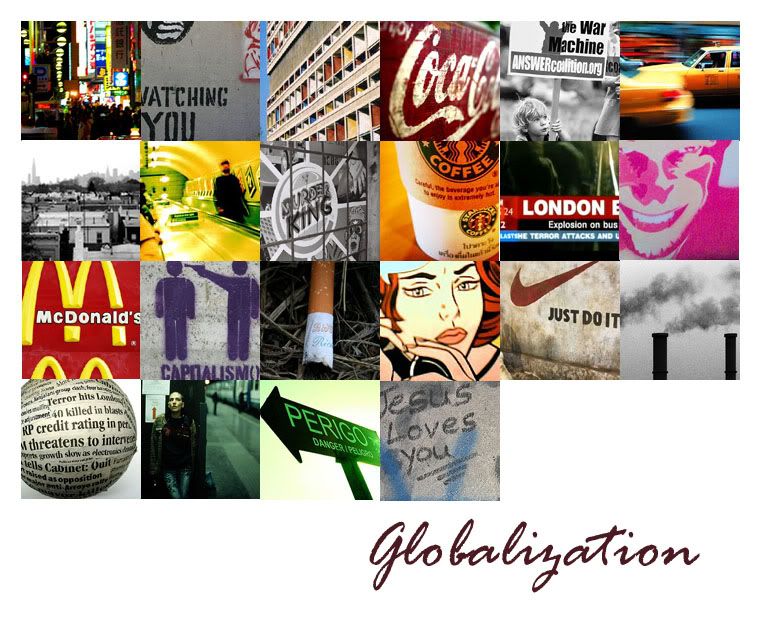
Photo montage by Olivia
The writer is proud to announce her retirement from globalization articles henceforth. Please do share your thoughts or criticisms. Thanks.
| Permalink | Trackbacks |
2 comment (s)
|
2 comment (s)


