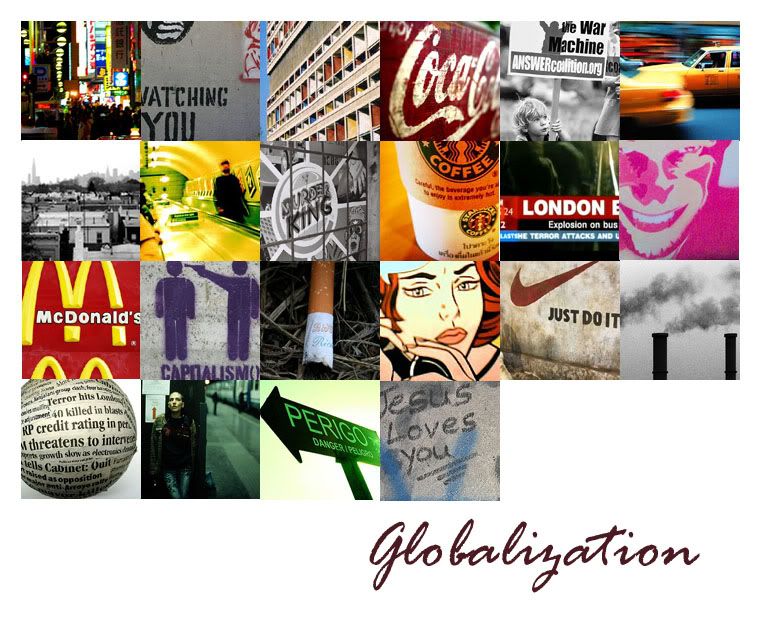
article: Going Global from the shortrun.com
Quote:
In my personal opinion, this cannot possibly be the case. It can be agreed that globalisation is a phenomena that we cannot stop, but being so, it does not necessarily mean that it is beneficial to all parties involved. However, it has well become acceptable that globalisation brings about industrialisation and economic growth, as well as the destruction of the environment. The destruction of our natural environment is ironically, global too. With the world knit together, the world would suffer together. Therefore if (for example) globalisation allows China to prosper, it will, in the process, cause irreversible harm to be inflicted onto the environment. Such dangers are already apparent – almost 20% of China is turning into a desert. If we wait till a country has fully developed before action is taken to save the environment, the effect might have very well become permanent before anything is done. Moreover, there are many countries all over the world, with many different countries undergoing industrialisation and such under the influence of globalisation at their own pace, chances are there would be many sources of pollution etc. at any one time. While one country cleans up, another continues harming the environment. Either way, the environment continues suffering.
In addition, it is not necessary for a country, after undergoing industrialisation, to care for the environment. Globalisation has brought everybody to harm the environment, but there are groups like Greenpeace fighting to preserve the environment. Treaties have been drawn up as well. A famous example would be the Kyoto Protocol, which even Singapore has ratified. Yet one important country has failed to ratify it – the country which produces the largest amount of pollutants into the environment – the United States of America. And their take is precisely the effect of globalisation, which is the fear of falling behind. Should they cut their emissions by their industries, USA would fall behind other countries. As the Kyoto Protocol only requires developed countries to ratify it, China and India are not covered. And as China and India are rising, they would pose as much threat as any fully developed country. Progress is often linked with globalisation, and as such, USA needed to maintain their position. As a result, the environment is very much neglected, even as a country reaches full development.
In conclusion, globalisation has brought more harm than good in terms of the environment. The competition brought about by globalisation spells bad news for the environment, despite there being international environmental groups. This problem, though caused by globalisation, could possibly be salvaged through globalisation – on the condition that the world is truly one. That, in my opinion, has not happened as although we are connected, countries still view another as opponents, and not as counterparts. Perhaps this could be corrected in the near future by globalisation.
The writer takes the stand of an environmental and health expert. –Teresa
Quote:
Most protestors come with a purpose; to protect the environment, to prevent child labor, to protect industries. Others claim that globalization will exploit weaker nations or steal markets from the richer. The sad thing about all of this is that the protests do little to aid their causes and in most cases, actually end up hurting the world in general. To see what I mean, let me give my take on each of these issues. (Granted, I am strongly biased in my opinion.)The argument the author of the article is presenting is that globalisation is essential in order for us to protect the environment. It is said that although globalisation brings about industrialisation and thus harm to the environment, economies prosper with globalisation. Therefore with the economy prospering, there would be enough resources for the protection of the environment.
The environment. Let me start off on the right foot, I strongly believe in protecting the environment, and I hope I can make this evident. Increasing trade will hurt the environment. Where's the argument? Businesses tend to hurt the environment so we should make sure that growing nations like China will not grow so they won't hurt their environment. There is some truth to this argument. The industrial revolution in Britain churned up so much smoke and soot that the trees were lined with black soot. It had disastrous effects for the environment and for the health of the English population. What happened? Progress happened, simply put, and the British passed a certain level of income. This development led them to stop worrying about the bare necessities like food and clothing, and they began concerning themselves with other goods such as clean air and water (yes clean air and water can be thought of as goods; they are called public goods.). Economists can show that for pretty much every country, this is true. Once individuals in the country reach a certain level of income (now it is around 4-5 thousand), they began to spend more on public goods. It makes intuitive sense that if I can provide for my family, I am more willing to spend to protect the environment. This trend pushes the idea that we should allow all nations free access to the global economy so that they can grow and develop. The richer a nation is, after this 4,000 to 5,000 income level, the more concerned it will become about protecting the environment. Therefore it is vital that the developed nations aid the undeveloped through freer markets.
In my personal opinion, this cannot possibly be the case. It can be agreed that globalisation is a phenomena that we cannot stop, but being so, it does not necessarily mean that it is beneficial to all parties involved. However, it has well become acceptable that globalisation brings about industrialisation and economic growth, as well as the destruction of the environment. The destruction of our natural environment is ironically, global too. With the world knit together, the world would suffer together. Therefore if (for example) globalisation allows China to prosper, it will, in the process, cause irreversible harm to be inflicted onto the environment. Such dangers are already apparent – almost 20% of China is turning into a desert. If we wait till a country has fully developed before action is taken to save the environment, the effect might have very well become permanent before anything is done. Moreover, there are many countries all over the world, with many different countries undergoing industrialisation and such under the influence of globalisation at their own pace, chances are there would be many sources of pollution etc. at any one time. While one country cleans up, another continues harming the environment. Either way, the environment continues suffering.
In addition, it is not necessary for a country, after undergoing industrialisation, to care for the environment. Globalisation has brought everybody to harm the environment, but there are groups like Greenpeace fighting to preserve the environment. Treaties have been drawn up as well. A famous example would be the Kyoto Protocol, which even Singapore has ratified. Yet one important country has failed to ratify it – the country which produces the largest amount of pollutants into the environment – the United States of America. And their take is precisely the effect of globalisation, which is the fear of falling behind. Should they cut their emissions by their industries, USA would fall behind other countries. As the Kyoto Protocol only requires developed countries to ratify it, China and India are not covered. And as China and India are rising, they would pose as much threat as any fully developed country. Progress is often linked with globalisation, and as such, USA needed to maintain their position. As a result, the environment is very much neglected, even as a country reaches full development.
In conclusion, globalisation has brought more harm than good in terms of the environment. The competition brought about by globalisation spells bad news for the environment, despite there being international environmental groups. This problem, though caused by globalisation, could possibly be salvaged through globalisation – on the condition that the world is truly one. That, in my opinion, has not happened as although we are connected, countries still view another as opponents, and not as counterparts. Perhaps this could be corrected in the near future by globalisation.
The writer takes the stand of an environmental and health expert. –Teresa
| Permalink | Trackbacks |
2 comment (s)
|
2 comment (s)


