With reference to the article, The Globalisation of Obesity, 11-13-2005, from Globalisation101.org
The Globalisation of Obesity.
Indeed, globalisation has contributed to the problem of obesity all over the world, according to the article, in 2 major ways. The first would be that globalisation led to technology and ease of migration, which changed these people’s diet. The next would be that globalisation had allowed fast food restaurants and so called ‘junk food’, to spread all over the world, which also affected people’s diet.
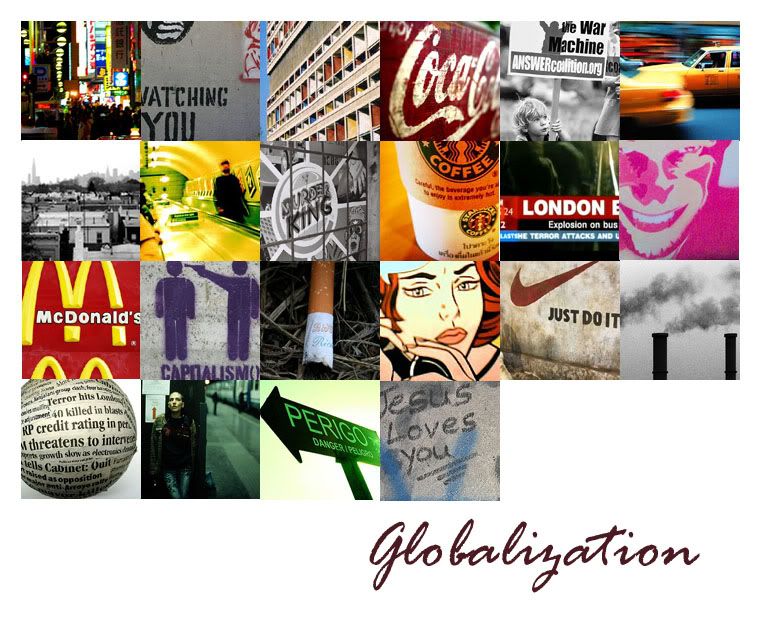
We all know what McDonald’s is. What is even weirder to note, is that, according to a survey of 7000 people from 6 different countries by Sponsorship Research International [Haywire Priorities, TODAY, Wednesday, April 19, 2006, page 3], nearly 80 per cent identified McDonald’s arches, as compared to the only 54 per cent that succeeded with the Christian cross. Such a result, though we might find weird and disturbing, is not surprising. McDonald’s is everywhere. There is a McDonald’s restaurant in almost every district in every country. Take a walk down Chinatown, and you would notice [to your delight?] that there are 3 branches in just that stretch of a few kilometres. One would think that Chinatown, an area mostly viewed as nostalgic and still holds most of the elements belonging to the past, would be spared from the ‘onslaught’ of the McDonald’s ‘empire’. Of course, there is McDonalds are not the only culprit. But the fact is that fast food is not our native staple diet, and that its appearance over the globe has changed the way things used to be. Just for convenience sake in our fast paced lives, many turn to McDonalds and other similar fast food chains. Had McDonalds not enter countries outside the US due to globalisation, we might not have incorporated fast food and soft drinks as part of our lifestyle. If each country was on its own, we might just be eating our rice and vegetables. But of course this is not possible. For if we were to isolate ourselves, and every other country similarly, Singapore might have a problem getting food supplies to feed her people. Therefore the food which possibly influences us and affects our health cannot be stopped without totally isolating ourselves, something which we cannot afford to let happen.
The problem of obesity is not only a country’s own. Take for example the number of obese citizens in USA on the rise. Obesity comes about due to our bad eating habits involving processed foods with high levels of fat, sugar and salt. This means that fast food outlets are not the only contributors to this. The various factors which results in their obesity [though mostly fast food] are present in almost all societies, thanks to Globalisation. Therefore, we too are at risk. To combat this, we need international cooperation. Globalisation has resulted in the increase in obesity, yet in order to combat this problem, we cannot condemn globalisation, but instead, we should use it to our benefit. For example, we have our World Health Day on every 7th April. On this day around the globe, thousands of events mark the importance of health for productive and happy lives.
What would be heartening is for countries to put aside their differences and come together to think of ways to prevent the rise in obesity. Rules and regulations might help, and perhaps an exchange in culture and lifestyle might help too. Whichever the method, globalisation has indeed affected the health of people around the globe, and thus we should make full use of globalisation to combat it.
This writer assumes the role of environment and health expert. =)
-Teresa
 |
5 comment (s)
|
5 comment (s)


