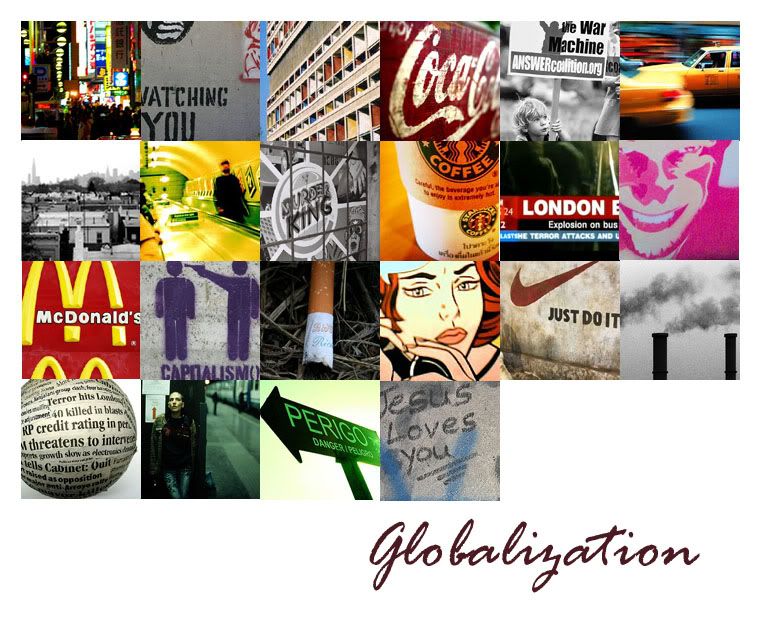
The idea that American culture is encroaching on the rest of the world is not a new one. Richard Pells writes in the Chronicle of Higher Education that, as early as 1901, Briton William Stead published a book with the foreboding title The Americanization of the World. The 1904 World’s Fair in St. Louis, MO was billed as a celebration of the 100th anniversary of the Louisiana Purchase. The fair ignited overseas anti-American backlash, however, when exhibits instead tended to celebrate an alleged American cultural, political, and even ethnic supremacy.
More recently, fears that American culture might usurp the rest of the world could be traced to the Marxist social critic Herbert I. Schiller. Schiller’s breakthrough book, Communication and Cultural Domination, was published in 1976, and was a critique of the post World War II influx and influence of American corporation across international borders. In the mid-1980s, the debate again heated up when the dramatic series Dallas gained enormous popularity outside the United States. The show’s mass appeal seemed to validate many of Schiller’s theories, and sparked “cultural preservation” movements in Europe.
Article by Radley Balko for aworldconnected.org
The world 'americanization' is no longer as it was used in the early 1900s. In the 21st century of today the definition 'the conversion and assimilation of American immigrants into Americans' in a cynic's dictionary has expanded to include the rest of the world. For others, the word has become synonymous with globalization; critics view it as nothing more than the imposition of American culture on the world. Activists see it as a fundemental threat to undermine cultural diversity. The rest of us drink Coke, eat Big Macs, watch Hollywood films, listen to Michael Jackson on the radio, and use Windows systems with characteristic nonchalance. Our Mickey Mouse ears are badges of pride. The most visible sign of globalization is in fact the availability of burgers and cola in nearly every country in the world. Leave it to the Americans to brand and globally market it, because we like the convenience.
In fact, the title of this blog, cocacolonization (a portmanteau of the term colonization and the giant soft drink corporation Coca-Cola) can also be used interchangeably with globalization, and implies an inclination towards Westernization or Americanization. While this term is arguably applied more commonly to the cultural aspect--a dangerous invasion of Western or American cultural values, cries Wikipedia--the so-called Americanization of the world is observable even in other aspects. The American economy is an ubiquitous factor in the world of economics, and through large corporations preach the good that is American capitalism. Wars are fought in the quest of American ideals of peace and democracy. The justification is debatable, but the occurances are undeniable.
Yet, to carelessly dismiss or to demonize globalization as mere Americanization is a tragic oversimplification of the complex issue the world is facing. Globalization is much more than just everyone watching the same movies or eating the same food. Its effects, depending on where you're standing, can be empowering, demeaning, or something in between.
Thomas Friedman, a columnist for the New York Times, quotes historian Richard Steel sometime back in 1998 in a disturbingly indicative piece of the troubles that the world, more significantly America, would and have in recent years come to face.
'...For the rest of the world, we are wild, crazy revolutionaries, with
rings in our noses and paint on our toes, overturning cultures and traditions
wherever we go. "We believe that our institutions must confine all others to the
ash heap of history," says Steel. "We lead an economic system that has
effectively buried every other form of production and distribution -- leaving
great wealth and sometimes great ruin in its wake. The cultural messages we
transmit through Hollywood and McDonald's go out across the world to capture and
also undermine other societies. We are the apostles of globalization, the
enemies of tradition and hierarchy." '
Why those angry men want to kill America, by Thomas Friedman, republished in The Houston Chronicle
Much of the debate concerning the effect of globalization on culture is simply passed for conventional wisdom, so much so that many anti-globalization activists (globaphobes if you like) put global companies such as Disney or Coca-Cola into a little box with a big red cross and the words 'cultural vandals' stamped across the side. Globalization for them is Americanization, a simple, one-sided accusation of the apparent cultural hegemony of the United States as cultural blasphemy. It is a relatively easy argument to sustain, with McDonald's and Starbucks franchised outlets looming in the background, and nevertheless one that makes things a whole lot simpler for them by providing them an identifiable target to channel their discontent and rage towards.
Fears that globalization is imposing a deadening cultural uniformity are understandable, but to say that local cultures and national identities face certain death in light of all-American consumerism may be an extremist stand to take. More often than not, what we deem to be Americanization--cultural imperialism shipped over from across the Atlantic--is but a mere semblance of American culture. Cultural pessimists can simply interpret the somewhat frivolously packaged influence as promoting the commercial at the expense of the authentic, and substituting shallow gratification for deeper satisfaction.
The people who see the silver lining to globalization beg to differ.
If critics of globalization were less obsessed with "Coca-colonization,"
they might notice a rich feast of cultural mixing that belies fears about
Americanized uniformity. Algerians in Paris practice Thai boxing; Asian rappers
in London snack on Turkish pizza; Salman Rushdie delights readers everywhere
with his Anglo-Indian tales. Although -- as with any change -- there can be
downsides to cultural globalization, this cross-fertilization is overwhelmingly
a force for good.
The beauty of globalization is that it can free people from the tyranny of
geography. Just because someone was born in France does not mean they can only
aspire to speak French, eat French food, read French books, visit museums in
France, and so on. A Frenchman -- or an American, for that matter -- can take
holidays in Spain or Florida, eat sushi or spaghetti for dinner, drink Coke or
Chilean wine, watch a Hollywood blockbuster or an Almodóvar, listen to bhangra
or rap, practice yoga or kickboxing, read Elle or The Economist, and have
friends from around the world. That we are increasingly free to choose our
cultural experiences enriches our lives immeasurably. We could not always enjoy
the best the world has to offer.
Globalization not only increases individual freedom, but also revitalizes
cultures and cultural artifacts through foreign influences, technologies, and
markets. Thriving cultures are not set in stone. They are forever changing from
within and without. Each generation challenges the previous one; science and
technology alter the way we see ourselves and the world; fashions come and go;
experience and events influence our beliefs; outsiders affect us for good and
ill.
Cultural Globalization Is Not Americanization, by Philippe Legrain for The Chronicle
The counter argument to Americanization is that globalization is not completely Western- or American- dominated. It may have started out that way, but it no longer is. Observations cited are the increase in Mexican and Chinese takeout outlet in America, and the popularity of Indian curry in Britan, as much as the availability of foie gras and pasta in China or Singapore. We don't watch as much baseball or rugby as much as we do soccer, and Asian martial arts like judo, karate, kick boxing and even pastimes such as yoga and tai chi are taught and practised in various parts of the world.
In the relentless quest to push the blame to America, it is easy to not only neglect the economic and cultural influence of many other countries, but also exaggerate the implications of globalization on the world. Legrain states in the same article that many of such fears are unfounded:
Even though American consumer culture is widespread, its significance is
often exaggerated. You can choose to drink Coke and eat at McDonald's without
becoming American in any meaningful sense. One newspaper photo of Taliban
fighters in Afghanistan showed them toting Kalashnikovs -- as well as a sports
bag with Nike's trademark swoosh. People's culture -- in the sense of their
shared ideas, beliefs, knowledge, inherited traditions, and art -- may scarcely
be eroded by mere commercial artifacts that, despite all the furious branding,
embody at best flimsy values.
The really profound cultural changes have little to do with Coca-Cola.
Western ideas about liberalism and science are taking root almost everywhere,
while Europe and North America are becoming multicultural societies through
immigration, mainly from developing countries. Technology is reshaping culture:
Just think of the Internet. Individual choice is fragmenting the imposed
uniformity of national cultures. New hybrid cultures are emerging, and regional
ones re-emerging. National identity is not disappearing, but the bonds of
nationality are loosening.
People fail to recognise and, in a sense, credit national and ethnic identity. If eating burgers and succumbing to coffee cravings at Starbucks makes one any less French, or Malaysian, or Singaporean, then the weakness must be inherent, stemming from perhaps little faith in one's own nationality to begin with. If anything, cultural globalization is a test of faith. That, and a test of the ability to discern for oneself, to consciously accept and resist foreign influence. To be able to enjoy the benefits and sieve out the harm.
The spirit that pulls through unbattered by external influence is bound to be stronger and more mature. That is something the world should strive for, to break out of dwelling in petty arguments over the pressures of foreign cultures as excuses for weak personalities and identites. Globalization is something we cannot, and cannot afford to resist, nor can the effects be reversed. It simply is a set of circumstances which the 21st century presents us, and humans being the adaptable, resillient species that we are, should make the most out of it.
That, of course, is considering we don't kill ourselves first. Global warming and bird flu are very real problems.
The writer assumes the role of a commentator on globalization and its effects on global and local culture. If her stand seems somewhat incoherent it is only because she is in the process of forming her own opinions on the matter. The key, she supposes, is to keep an open mind and be optimistic. The sources cited in this article are undeniably impressive, and everyone should go read the actual articles by real writers. Thanks for reading (if anyone is).
Recommended reading
Can pop-cultural imperialism be stopped?
by Brigitte Pellerin
Cultural Globalization Is Not Americanization
By Philippe Legrain
Why those angry men want to kill America
By Thomas L. Friedman
Globalization & Culture: Americanization or Cultural Diversity?
by Radley Balko
| Permalink | Trackbacks |
0 comment (s)
|
0 comment (s)


