
Years later, colour is still what takes me south-by-southeast to Asia -
colour and life and light. The Buddha-, Shiva-, Allah-laden light of
1,000-year-old temples, the rain-like light of Burma and Cambodia, and the
rocket-pulverized dust of Afghanistan where tribal wars continue to rage.
Wherever you go in that part of the world, there is the riot of life carried out
in the streets and bazaars. And, like the overpowering weather, there is
religion that controls life with a force the West hasn't known since the
Renaissance.
It is this unbroken continuity with the past and ancient beliefs that
still takes me back to Asia, and it's a quality unique in the world. In India in
particular, where millions have no home but the streets, virtually every life
event is carried out in public: prayer, eating, sleeping, nursing, crude
dentistry, even bodily functions. In the secular West, where nothing is sacred,
everything seems hidden; yet in Asia, where nothing is hidden, everything is
sacred.Source: http://www.culturesontheedge.com/gallery/exhibits/steve_mccurry/index.html
Steve McCurry begins his book with powerful words, because it is only words that carry such ardent passion and strength, is justice done to the culturally diverse and spiritually-rich environment he attempts to present to the rest of the world. A series of intricately-documented photographs and patiently worded personal insights into the lives of people there can only tell so much of its story. The rest is left to the human mind-- inexperienced and foreign-- to wonder and to weave fascinating tales of a land little explored.
In today's world it should almost be a priviledge to be carefully shielded from the rest of society by a unfamiliar mist. Globalization has rendered any part of the world incapable of progressing without embracing global thought in terms of politics, economics, and technology. With the diffusion of politicial ideas and systems, the dissemination of infomation through a extended cyberspace network, and the sharing of capital and goods through trade have made it inevitable that along the way, some native cultures should have already been misplaced, or forgotten as newer, perhaps more practical concerns take centre stage.
The penetrating effects of globalization in terms of culture have taken root without notice, however, and it is only with the sudden realization of the erosion of traditional values and practices that the extent to which external influences have taken hold in an area become obvious.
If there is a biological web of life, there is also a cultural and spiritual web of life--something people have taken to calling the 'ethnosphere'--the sum total of all the thoughts, beliefs, myths, and institutions brought into being by the human imagination. It is what can be thought of as humanity's greatest legacy, embodying everything we have produced as a curious and amazingly adaptive species. It is not the number of nuclear weapons we possess, or the extent of development our country has reached, but what society should be measured by should be the flourishing of unique culture. The ethnosphere is as vital to our collective well-being as the biosphere. And just as the biosphere is being eroded, so is the ethnosphere--if anything, at a far greater rate.
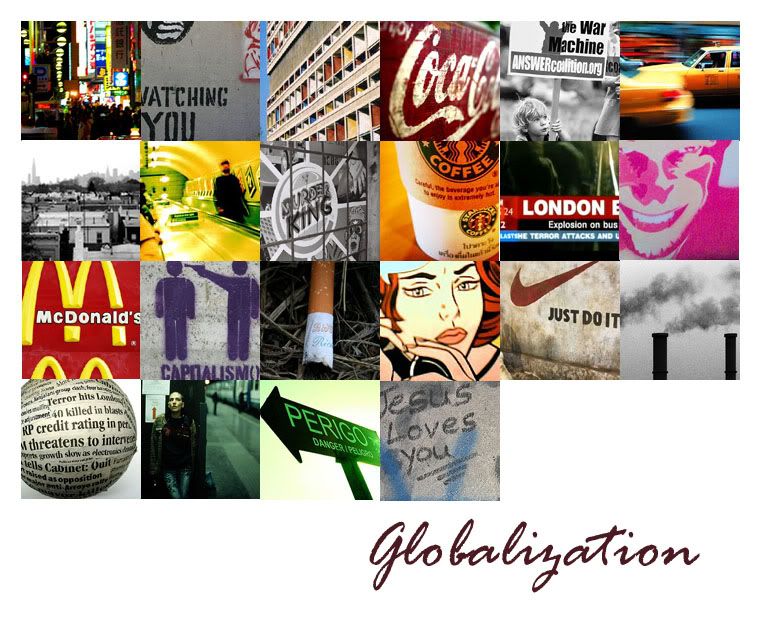
With the assault of global businesses and franchises preaching a new subculture to be accepted by all part of the world as local culture, it is easy for traditional cultures to fade away. Products of world-known brands such as Nike and Adidas promote what can be considered a global culture. Teenagers from all over the world wearing the same type of shoes, drinking the same type of soda, smoking the same type of cigarettes; it helps people identify with one another.
Then again, how much closer can we feel to someone half the world away?
When asked the meaning of being human, all the diverse cultures of the world respond with 10,000 different voices. Distinct cultures represent unique visions of life itself, morally inspired and inherently right. Those different voices then become part of the overall repertoire of humanity for coping with challenges confronting us in the future. As we drift toward a blandly amorphous, generic world that globalization welcomes; as cultures disappear and life becomes more uniform, we as a people and a species, and Earth itself, will be deeply impoverished.
The steady loss of languages, reportedly declining at the rate of one every two weeks, is indicative of the demise of cultures. Language is not just a body of vocabulary or a set of grammatical rules, but also is the vehicle through which the soul of each particular culture comes into the material world. Out of the 6,000 languages still spoken on Earth years ago, less than half are currently taught to schoolchildren.
We hear of reports in the rise of Americans and Europeans studying Chinese due to the key influence which China, arguably a rising superpower, now affects global economies and politics. What proportion of the statistics choose to learn the language or embrace the culture because of its inherent beauty and age-old cultural traditions? I view with much contempt the motivations of people who attempt the language; the belief that such manoveures will put them in favourable positions in the future. Language has become but a single-dimensional tool in which people communicate in the world; priority goes to that which is the most widely used and accepted.
What this means is that we are living through a period of time in which, within a single generation or two, by definition half of humanity's cultural legacy is being lost in a single generation. Whereas cultures can lose their language and maintain some semblance of their former selves, in general, it is the beginning of a slippery slope towards assimilation and acculturation and, in some sense, annihilation.
The whole notion of modernization and globalization then appears to be based on something of a false assumption: the idea that if the rest of the world follows the dictates of a 'successful' development paradigm, they will achieve the level of material well-being that the 'success' brings.
It is neither change nor technology that threatens the integrity of the ethnosphere. It is power-- the crude face of domination. In every instance, these societies should not be labelled as failed attempts of modernity. They are not archaic, destined to fade away, but rather they are dynamic, living, and vital cultures that are being driven out of existence by identifiable external forces. Whether it is diseases that have come into the homeland of the Yanomami in Brazil, or the fact that the Ogoni in the Niger Delta find their once-fertile soils poisoned by the local petroleum industry, or whether in Sarawak the forest homelands of the Penan have been destroyed, there is always an identifiable element. This is both discouraging and encouraging, for if human beings are agents of cultural destruction, we can also be facilitators of cultural survival.
It is a myth that the inevitable twin effect of globalization is cultural diffusion. It only appears to be that way because we allow it to be so. But till there is concerted effort from societies all over the world we can only watch as the myraid of cultures elude us in our race for continual progress.
This response was inspired by a certain website that the writer chanced upon, Cultures on the Edge, an online site to raise global awareness about threatened cultures around the world. Its gallery allows visitors a brief glimpse into South Southeast, a book by Steve McCurry, examining the state of world culture today in various parts of Asia through photography and personal experiences. McCurry is a renowned photographer whose coverage of many areas of international and civil war including the Iran-Iraq war, Beirut, Cambodia, the Philippines, and the Gulf War have won him several awards. The rest of the website contains numerous articles and photographs pertaining to the erosion of traditional culture in face of larger political, cultural, and economic forces.
This writer assumes the role of a commentator on globalization and this phenomenon's resonating effect through the 21st century world with regards to culture.
Photograph credited to Steve McCurry.
| Permalink | Trackbacks |
3 comment (s)
|
3 comment (s)


