
The world has since seen four years since the tragedy. To many of us it has become but a poetic idea, carelessly dismissed as a barbaric act of terrorism, a crass display of searing footage, statistics, photographs, a haphazard collection of lives shoved in sideways to construct a poignant tale. The causes of which were, and still are furiously debated, and its reverberations on the world something to be studied in the future with the benefit of hindsight--an unabsorbable nightmare condensed into two pages of a textbook. Just another event in the larger scheme of things.
For months afterward the disaster was the lead story in every newspaper in the world. Aid poured in in the form of medical workers, volunteers, as did the condolences, from countries all over the world.
I can tell you I watched it on BBC, I can quote you statistics, important pronouncements, dates, but then again so can millions of people. What I cannot convey, is the grief of loss. I cannot tell you I had any particular emotional connections with the tragedy. I have never visited the World Trade Centre, nor do I have relatives or friends living in New York. The fact remains, however, that despite all of this, I have found myself inextricably (and inexplicably) emotionally involved in all of this.
To some extent it has affected me on a personal level. I'm sure many can say the same, even without any direct or obvious links with what has happened.
Because the world is a small place.
Because painfully raw human emotions cross any number of geographical and cultural boundaries.
Because the memory what happened that Tuesday morning would remain a blot in the history of not only the United States but of the world, a reminder to all of us; saying that in order to make sense of this terrifying new phase at the turn of the century, we must break down the barriers that divide us.
And because it is impossible to remain detached and aloof as one watches the live broadcast as, in the space of 92 minutes, two of the world's tallest buildings come crashing to the ground in an act of planned destruction.
Millions of people across nations-- anyone with access to cable, or even just a television-- and feeling the same fear, shedding the same tears, all at the same time. There is no need for direct emotional connections, because hatred, fear, sympathy, shock, disgust, sadness and love are intangible and free from human-defined political, geographical or cultural borders. After the shock fades away, there are the reports of people plastering the streets with hastily-produced posters, displaying photos and descriptions of missing friends, family and loved ones - particularly as they have had to resort to such basic methods in a thoroughly modern city. One has to be moved by the tears of Americans trying to understand the violence that had been unleashed across their country, taking numerous innocent lives, and shattering the hearts of the ones left behind.
Besides announcing the face of one city's tragedy, what the media has done is to project the increasingly real problem of terrorism. Something that does not respect borders. After 9/11, New York could be anywhere.
Many people liken the World Trade Centre attacks to that of one sixty years ago, in 1941, on Pearl Harbour. I beg to differ. It is not just the fact that the number of innocent casualities were multiplied, or that the motivations behind the second attack are far more disturbing, but also because this disaster has been reported through a huge number of personal accounts on the internet, as well as in the media, through books and newspapers that are available everywhere. This means that we are able to gain a uniquely human perspective on events, more so than at any other time in history.
Ultimately, though, it all comes back to the fact that these events have made me appreciate how small the world really is. As individuals, many of us may not have any direct connection with what has happened, but the untold thousands of lives lost-- in a country that sends and receives people from all corners of the world-- means that the effects could reach surprisingly close to home.
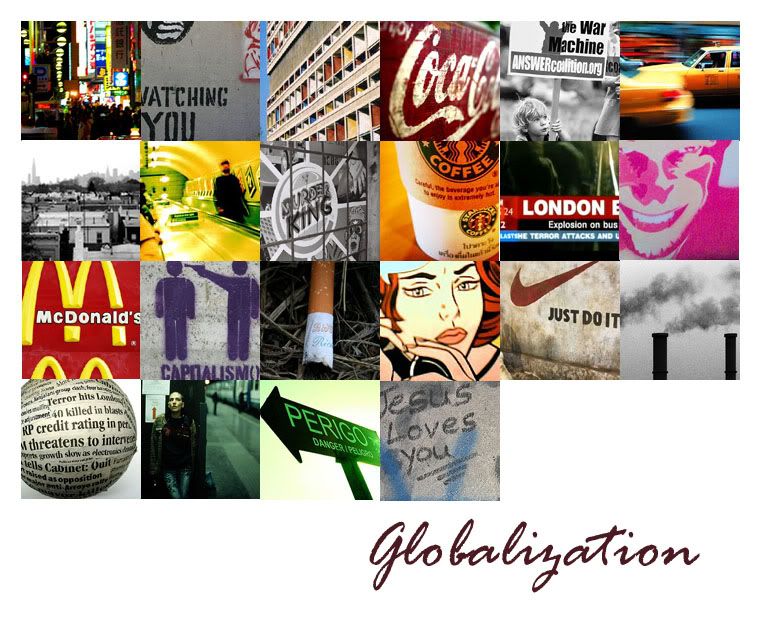
It is a relatively simple task of just labelling the various observable trends of globalization, a 21st century phenomenon, like worldwide trade and economic activity, or the diffusion of culture across borders (cultural homogenization if you like). What is more important is that we realise that individuals are no longer confined within the barriers of the human heart. It may take a disaster this alarming in magnitude to show the people of the world, globalization is not necessarily about the things we can see, or predict, but also about the finer details of the human race-- the ability to think and feel for one another, but it should be done. And to be able to do so regardless of nationality or ethnicity, is in itself admirable progress of the 21st century.
This writer assumes the role of a commentator on globalization and this phenomenon's resonating effect through the 21st century world with regards to culture. All thoughts and ideas are original.
Photograph credited to Alton Thompson, on flickr.com.
| Permalink | Trackbacks |
4 comment (s)
|
4 comment (s)


